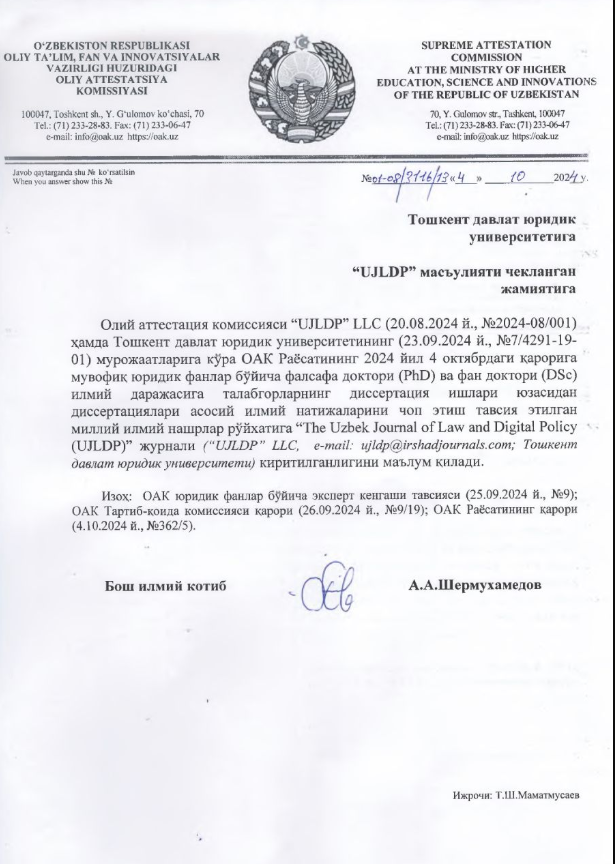
Ethical Principles and Publication Policy
The Uzbek Journal of Law and Digital Policy (UJLDP) is committed to maintaining high standards of academic integrity, responsible authorship, editorial independence, and ethical scholarly publishing. The Journal expects authors, editors, reviewers, and the Publisher to act honestly, transparently, and responsibly throughout the submission, review, publication, and post-publication processes.
UJLDP's publication ethics framework is informed by internationally recognized standards of scholarly publishing, including the principles and practices of the Committee on Publication Ethics (COPE).
A. Originality and Responsible Publication
Authors must submit original work that has not been published previously and is not simultaneously under consideration by another journal.
Authors must accurately acknowledge the work of others and must not engage in plagiarism, duplicate publication, redundant publication, fabricated or falsified research, or other forms of academic or publication misconduct.
Specific procedures concerning plagiarism and substantial textual overlap are established in the Journal's separate Plagiarism Policy.
B. Authorship and Contributorship
Authorship must accurately reflect the individuals who have made a substantial intellectual contribution to the research and manuscript.
All listed authors must have made a meaningful contribution to the work and must have approved the final version submitted for publication. Individuals who have not made an authorship-level contribution should not be listed as authors.
The Journal does not permit ghost authorship, guest authorship, honorary authorship, or other forms of inappropriate authorship attribution.
Each author must provide an appropriate Author Contribution Statement identifying their contribution to the study and manuscript, including, where applicable, conceptualization, research design, data collection, legal analysis, drafting, critical revision, and final approval.
Changes to authorship after submission must be justified and approved by all affected authors. The Journal may request appropriate documentation before approving an authorship change.
C. Author Responsibilities
Authors are responsible for ensuring that the information presented in their manuscripts is accurate, properly supported, and honestly reported.
Authors must disclose relevant sources of funding, competing interests, institutional affiliations, and other circumstances that could reasonably be perceived as affecting the research or its interpretation.
Authors must obtain appropriate permission for copyrighted third-party material and comply with applicable legal and ethical requirements governing their research.
Authors must promptly notify the Journal if they discover a significant error or inaccuracy in their published work and must cooperate with the Journal in determining an appropriate response.
D. Research Integrity and Data
Authors must present research findings, legal analysis, empirical evidence, and other research materials accurately and without fabrication, falsification, or deliberate misrepresentation.
Where empirical or data-based research is undertaken, authors should retain appropriate research records and supporting materials sufficient to substantiate the reported findings.
Where appropriate and legally permissible, authors should provide sufficient information concerning data sources, research procedures, analytical methods, and other relevant materials to enable appropriate evaluation of the research.
The nature and extent of data availability may vary according to the research methodology, applicable law, confidentiality obligations, privacy requirements, and the characteristics of the research.
E. Ethical Oversight and Research Participants
Authors conducting research involving human participants, personal data, confidential information, vulnerable groups, or other activities requiring ethical oversight must comply with applicable ethical and legal requirements.
Where ethics approval, informed consent, consent for publication, or another form of formal ethical authorization is required, authors must obtain it before conducting the relevant research and provide appropriate information concerning the approval in the manuscript where applicable.
Where disclosure of ethical or participant information could compromise privacy, confidentiality, safety, or legal obligations, the author must explain the applicable basis for withholding such information.
F. Conflicts of Interest
Authors, reviewers, editors, and members of the editorial team must disclose any actual, potential, or perceived conflict of interest that could reasonably affect their independence or impartiality.
Conflicts may include financial, professional, institutional, personal, academic, or other relevant interests.
The existence of a disclosed conflict does not necessarily prevent participation in the publication process. The Journal shall determine whether appropriate safeguards are required to protect the independence and integrity of the process.
G. Editorial Independence
Editorial decisions shall be based on the scholarly quality, originality, relevance, methodological or analytical rigor, and suitability of the manuscript.
Editorial decisions shall not be improperly influenced by commercial interests, publication charges, personal relationships, institutional affiliations, nationality, gender, religion, political views, or other irrelevant considerations.
The payment or waiver of an Article Processing Charge (APC) or other publication fee shall not determine whether a manuscript is accepted or rejected.
H. Confidentiality
Manuscripts submitted to IJLP and information obtained during the editorial and peer review process shall be treated as confidential.
Editors, reviewers, and other persons involved in the editorial process shall not disclose or use confidential manuscript information except as necessary for legitimate editorial purposes.
The specific confidentiality requirements applicable to peer review are established in the Journal's Peer Review Policy and Reviewer Guidelines.
I. Use of Artificial Intelligence
Authors must disclose the use of artificial intelligence or other automated tools where their use materially contributes to the preparation, analysis, generation, or modification of the manuscript, in accordance with the Journal's applicable submission requirements.
Artificial intelligence systems or automated tools must not be listed as authors.
Authors remain fully responsible for the accuracy, originality, legality, integrity, and scholarly content of their submissions, including content generated or modified with the assistance of such tools.
Authors must not use artificial intelligence to fabricate sources, authorities, data, quotations, citations, legal propositions, or research findings.
Reviewers and editors must not upload confidential manuscripts or unpublished editorial materials into external artificial intelligence systems where doing so may compromise confidentiality or permit unauthorized use or retention of the material.
J. Publication Misconduct
UJLDP takes allegations of publication misconduct seriously, whether identified before or after publication.
Potential misconduct may include, but is not limited to:
- Plagiarism or substantial inappropriate textual overlap;
- Duplicate or redundant publication;
- Fabrication or falsification of research or data;
- Manipulation or misrepresentation of sources or findings;
- Inappropriate authorship or contributorship;
- Undisclosed conflicts of interest;
- Misuse of confidential information obtained through peer review;
- Unauthorized use of copyrighted material; or
- Other conduct that materially undermines the integrity of the scholarly publication process.
Where a concern is identified, the Journal may request an explanation or supporting documentation from the relevant parties and may undertake an appropriate editorial assessment or investigation.
The Journal may consult relevant institutions, funding bodies, or other appropriate authorities where necessary and legally permissible.
K. Allegations and Investigation
Allegations of publication misconduct may be raised by authors, reviewers, editors, readers, institutions, or other persons with relevant information.
The Journal shall assess allegations objectively and shall provide the relevant author or authors with an appropriate opportunity to respond where the circumstances require.
The Journal may request supporting evidence, relevant documentation, or clarification from the parties concerned.
Where an allegation requires investigation beyond the Journal’s authority, the matter may be referred to the relevant institution, employer, research organization, funding body, or other competent authority.
The Journal shall seek to maintain confidentiality during an investigation to the extent reasonably possible.
L. Editorial and Reviewer Misconduct
Editors and reviewers are expected to maintain independence, confidentiality, and professional integrity.
Editors and reviewers must disclose relevant conflicts of interest and must not use unpublished information obtained through the editorial or peer review process for personal, academic, financial, or professional advantage.
Concerns regarding the conduct of an editor or reviewer shall be assessed by an appropriate editorial authority independent of the person whose conduct is being questioned, where reasonably practicable.
M. Complaints and Appeals
Authors may submit a complaint or appeal concerning an editorial or publication-related decision where they believe that the Journal’s procedures were not properly followed or that a relevant decision was based on a material error or inappropriate consideration.
Complaints and appeals should be submitted in writing by email and should clearly state the grounds and provide relevant supporting information.
The Journal shall review complaints and appeals fairly and independently and shall communicate the outcome within 14 days, having regard to the complexity of the matter.
An appeal does not guarantee reversal of an editorial decision.
N. Post-Publication Concerns
Publication does not prevent the Journal from addressing concerns concerning the accuracy, integrity, authorship, or ethical status of a published article.
Where a credible concern is identified after publication, IJLP may conduct an appropriate assessment and may take action in accordance with the circumstances and the Journal’s applicable policies.
Where established misconduct materially affects a published article, the Journal may take appropriate action, including removal of the published article in accordance with its Plagiarism Policy, where the relevant conditions are satisfied.
O. Corrections and Retractions
Where an error or misconduct is established after publication, the Journal may take appropriate corrective action in accordance with the nature and seriousness of the matter.
Such action may include correction, withdrawal, removal, or retraction where justified by the circumstances and applicable policy.
The Journal shall determine the appropriate action on the basis of the reliability and integrity of the published work and the nature of the established problem.
P. Editorial Board and Journal Staff
Members of the Editorial Board and Journal staff must perform their responsibilities professionally, independently, and transparently.
Where a manuscript is submitted by an Editor, Editorial Board member, or another person closely associated with the Journal, the Journal shall take appropriate measures to ensure that the manuscript receives an independent and impartial assessment.
No individual shall participate in an editorial decision where a conflict of interest prevents an impartial assessment.
Q. Third-Party Material and Intellectual Property
Authors must respect copyright and other intellectual property rights when preparing manuscripts.
Permission must be obtained where required for the reproduction of third-party material.
Copyright ownership, author rights, licensing, and permitted reuse of published articles are governed by the Journal’s Copyright Policy and License Policy.
R. Funding and Financial Transparency
Authors must disclose financial support that materially contributed to the research or preparation of the manuscript.
The funding statement should identify the relevant funding organization, grant or project number where applicable, and any other information required by the Journal.
The absence of external funding should also be disclosed where requested through the Journal's submission system.
S. Relationship with Other Journal Policies
This Policy establishes the Journal’s general ethical and publication standards. It should be read together with the Journal’s separate:
- Plagiarism Policy;
- Peer Review Policy;
- Reviewer Guidelines;
- Instructions for Authors;
- Copyright Policy;
- License Policy;
- Open Access Policy;
- Repository Policy;
- Archiving Policy; and
- Publication Charges and Waiver Policy.
Where a specific issue is governed by a specialized Journal policy, that policy shall apply in conjunction with this Policy.
T. Compliance with International Publication Ethics Standards
UJLDP seeks to maintain its publication practices in accordance with internationally recognized standards of responsible scholarly publishing, including the Core Practices of the Committee on Publication Ethics (COPE) and other recognized standards applicable to the Journal’s field.
The Journal may consult relevant COPE guidance and procedures when addressing complex publication ethics matters, including allegations of misconduct, authorship disputes, conflicts of interest, complaints, peer review concerns, and post-publication issues.
Effective from: 01 September 2026
Last Updated: 21 August 2026