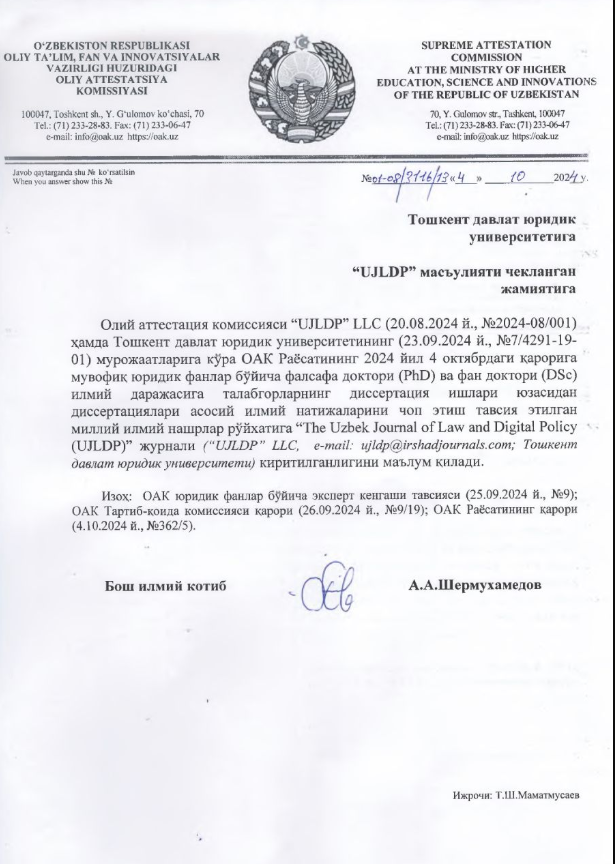
Instructions for Authors
The Uzbek Journal of Law and Digital Policy (UJLDP) publishes original, high-quality, and interdisciplinary scholarly research that contributes to the advancement of legal knowledge, public policy, and related disciplines. Compliance with these Instructions for Authors is assessed during the initial editorial screening conducted by the assigned Section Editor. Manuscripts that do not comply with these requirements may be returned to the corresponding author for technical revision before peer review or may be declined without external review. Compliance with these Instructions does not guarantee acceptance for publication.
These Instructions for Authors prescribe the mandatory requirements governing the preparation and submission of manuscripts to the Uzbek Journal of Law and Digital Policy (UJLDP). They are intended to ensure consistency in manuscript preparation, facilitate an efficient editorial and peer-review process, and maintain the highest standards of academic quality and scholarly publishing. Authors are expected to read these Instructions carefully before submitting a manuscript. Failure to comply with these requirements may result in the manuscript being returned for technical revision or declined prior to peer review.
A. Originality
Only original manuscripts shall be considered for publication. By submitting a manuscript to UJLDP, the corresponding author confirms that the manuscript has not been published previously, is not under consideration by another journal or publisher, and has been approved by all listed authors. Manuscripts shall comply with the Journal’s Publication Ethics Policy, Plagiarism Policy, and all other applicable editorial policies.
B. Manuscript Length
Original research articles shall contain not fewer than 6,000 words and not more than 10,000 words, excluding the bibliography. Manuscripts exceeding this limit may be considered only at the discretion of the Editor-in-Chief where the nature of the research justifies additional length.
C. Manuscript Formatting
Manuscripts shall be prepared using Microsoft Word (.doc or .docx) and formatted in accordance with the Journal’s template. The manuscript shall be typed in Times New Roman, 14-point font, with single-line spacing, justified text alignment, and moderate page margins on all sides. No additional spacing shall be inserted before or after headings or paragraphs. All pages shall be numbered consecutively.
D. Submission Files
All manuscripts shall be submitted exclusively through the Journal’s Online Journal System (OJS), via the “Make a Submission” function. The Journal does not accept manuscripts submitted by email, post, or any channel other than the OJS platform. Authors who do not already hold an OJS account shall register prior to submission.
Authors shall upload two separate files through the Online Journal System (OJS).
The Title Page shall contain the title of the manuscript, the full name of each author, institutional affiliation, country, ORCID iD (where available), the corresponding author’s email address, acknowledgements (where applicable), funding statement, Author Contribution Statement, Ethical Statement, Disclosure Statement, and Data Availability Statement.
The Anonymous Manuscript shall contain no information capable of identifying the author(s) or their institution. Authors should remove personal identifiers from document properties via the file’s properties or “Inspect Document” function, disable tracked changes and remove all comments, and avoid self-citation in a manner that discloses authorship (e.g., “as I have argued elsewhere”).
E. Title
The title shall accurately reflect the subject matter and principal focus of the research. It shall be centered, presented in bold type, and contain no more than fifteen (15) words. Titles shall avoid abbreviations, citations, footnotes, and unnecessary punctuation.
F. Abstract
Each manuscript shall include a single-paragraph abstract of not more than 150 words. The abstract shall briefly state the purpose of the research, the methodology employed, the principal findings, and the contribution of the study. Citations, references, footnotes, abbreviations, and unexplained acronyms shall not be included in the abstract.
G. Keywords
Immediately following the abstract, authors shall provide five (5) to eight (8) keywords that accurately represent the principal themes of the manuscript. Keywords should facilitate indexing and retrieval and should avoid unnecessary repetition of words appearing in the title.
H. Manuscript Structure
Research manuscripts should be organized according to the IMRAD structure, consisting of:
Introduction, Methodology, Results or Analysis, Discussion, and Conclusion.
The Introduction should clearly present the background of the study, problem statement, literature review, research gap, research objectives, research question(s), and the significance of the research.
The Methodology should explain the research design, research methods, data sources, data collection procedures (where applicable), and analytical methods employed.
The Results or Analysis section should present the research findings in a logical, coherent, and systematic manner, supported where appropriate by tables or figures.
The Discussion should critically interpret the findings, compare them with existing scholarship, and explain their theoretical, practical, or policy implications.
The Conclusion should summarize the principal findings, highlight the contribution of the research, acknowledge any limitations where appropriate, and provide recommendations or directions for future research.
I. Headings Structure
Authors shall use only the heading structure prescribed in the Journal Template. Main headings shall be numbered using Roman numerals (I, II, III, IV), first-level subheadings shall be identified using capital letters (A, B, C), and second-level subheadings shall be numbered using Arabic numerals (1, 2, 3). Additional heading levels shall not be used. The abstract shall not be included within the heading numbering system.
J. Tables and Figures
Tables, figures, graphs, charts, photographs, and other illustrations shall be placed within the relevant section of the manuscript and numbered consecutively. Each table or figure shall include a concise title and, where applicable, an appropriate source citation. Authors are responsible for obtaining permission to reproduce any copyrighted material.
Figures, photographs, and illustrations shall be submitted in a high-resolution format (minimum 300 DPI) suitable for print and digital reproduction.
Tables and figures shall each be numbered in a separate consecutive sequence (e.g., Table 1, Table 2; Figure 1, Figure 2).
K. References
All manuscripts shall comply with the Publication Manual of the American Psychological Association (APA), Seventh Edition, for both in-text citations and the reference list.
References shall consist primarily of scholarly books and peer-reviewed journal articles. Authors are strongly encouraged to cite recent, relevant, and authoritative literature that reflects the current state of scholarship. References shall be arranged alphabetically by the surname of the first author and, where necessary, chronologically for multiple works by the same author. Where more than one work by the same author has been published in the same year, the references shall be distinguished by the letters “a,” “b,” “c,” and so forth following the year of publication.
Every source cited in the manuscript shall appear in the reference list, and every reference included in the bibliography shall be cited within the text. References shall not be included in the abstract.
Authors shall use recognized reference management software, preferably Zotero, to ensure the accuracy and consistency of citations.
Every journal article, book chapter, dataset, report, or other electronic source included in the reference list must contain a Digital Object Identifier (DOI) or a stable Uniform Resource Locator (URL), where available. References that contain neither a DOI nor a stable URL may be returned to the author for correction or may not be considered by the Journal.
L. Author Contribution Statement
Every submission shall include an Author Contribution Statement identifying the specific contribution made by each listed author. The corresponding author is the individual responsible for communication with the Journal throughout the editorial and peer-review process, for ensuring that all listed authors have approved the final manuscript, and for responding on behalf of all authors to any queries arising after publication.
Please clarify this author’s role in the research by updating the CRediT roles of this author. Where authors do not meet the authorship criteria, please include their contribution in a separately headed “Acknowledgements” section.
Contributions shall be identified under one or more of the following categories:
- Conceptualization of the study;
- Research design;
- Data collection;
- Legal analysis;
- Drafting of the manuscript;
- Critical revision of the manuscript; and
- Final approval of the version submitted.
Example 1 – Single Author
Author Contribution Statement:
The author was solely responsible for the conceptualization of the study, research design, legal analysis, drafting of the manuscript, critical revision, and approval of the final version submitted for publication.
Example 2 – Two Authors
Author Contribution Statement:
Author A was responsible for the conceptualization of the study, research design, legal analysis, drafting of the manuscript, and final approval. Author B contributed to data collection, critical revision of the manuscript, and final approval.
Example 3 – Three or More Authors
|
Contribution |
Author(s) |
|
Conceptualization of the study |
Author A |
|
Research design |
Author A and Author B |
|
Data collection |
Author B |
|
Legal analysis |
Author A |
|
Drafting of the manuscript |
Author A |
|
Critical revision |
Author A and Author B |
|
Final approval of the version submitted |
All authors |
M. Ethical Statement
Every submission shall include an Ethical Statement appropriate to the nature of the research.
Example 1 – Doctrinal Legal Research
Ethical Statement:
This study employed doctrinal legal research based exclusively on publicly available legislation, judicial decisions, policy documents, and scholarly literature. Ethical approval was therefore not required.
Example 2 – Empirical Research
Ethical Statement:
Ethical approval for this research was granted by ________________________________________ (name of institution) under Approval No. ________________________. All participants provided informed consent before participating in the study.
Example 3 – Secondary Data Research
Ethical Statement:
This study relied exclusively on publicly available secondary data and documentary sources. No human participants or confidential personal information were involved. Accordingly, ethical approval was not required.
Example 4 – Interview-Based Research
Ethical Statement:
Ethical approval was obtained from ________________________________________ (name of ethics committee or institution) under Approval No. ________________________. Written informed consent was obtained from all interview participants prior to data collection.
N. Disclosure Statement
Every submission shall include a Disclosure Statement declaring any financial, professional, institutional, or personal relationships that could reasonably be perceived as influencing the research.
Example 1 – No Conflict of Interest
Disclosure Statement:
The authors declare that they have no financial or non-financial conflicts of interest in relation to this research.
Example 2 – Research Funding
Disclosure Statement:
The authors declare that the funding received for this research did not influence the design, methodology, analysis, interpretation, or publication of the study.
Example 3 – Institutional Affiliation
Disclosure Statement:
Author(s) ________________________________________ is/are employed by ________________________________________ (name of institution, organization, company, or agency). The author(s) confirm that this affiliation did not influence the design, conduct, analysis, interpretation, or conclusions of the study.
Example 4 – Professional Consultancy
Disclosure Statement:
Author(s) ________________________________________ has/have previously provided consultancy or professional services to ________________________________________. The author(s) declare that this relationship had no influence on the research reported in this manuscript.
O. Funding Statement
Every submission shall include a Funding Statement identifying all financial support received for the research and publication of the manuscript.
Example 1 – No External Funding
Funding Statement:
This research received no external funding.
Example 2 – Research Grant
Funding Statement:
This research was financially supported by ________________________________________ (name of funding agency, university, institution, or organization) under Grant or Project No. ________________________.
Example 3 – Institutional Research Funding
Funding Statement:
This research was supported by ________________________________________ (name of university, research Centre, or institution) through its research funding program under Project No. ________________________.
Example 4 – International Funding
Funding Statement:
This research was funded by ________________________________________ (name of international organization, donor, or funding body) under Grant Agreement No. ________________________.
P. Data Availability Statement
Every submission shall include a Data Availability Statement appropriate to the research methodology adopted.
Example 1 – Doctrinal Legal Research
Data Availability Statement:
No new empirical data were generated or analyzed during this study. All legal materials, policy documents, and scholarly sources used in this research are publicly available and appropriately cited in the reference list.
Example 2 – Quantitative Research
Data Availability Statement:
The datasets generated and analyzed during the current study are available from the corresponding author upon reasonable request.
Example 3 – Qualitative Research
Data Availability Statement:
Due to confidentiality obligations and the protection of participant anonymity, the interview transcripts supporting the findings of this study are not publicly available. An anonymized version may be made available upon reasonable request, subject to applicable ethical requirements.
Example 4 – Public Repository
Data Availability Statement:
The data supporting the findings of this study are publicly available from ________________________________________ (name of repository, database, or website).
DOI: ________________________________________
URL: ________________________________________
Example 5 – Institutional Repository
Data Availability Statement:
The research data supporting this study have been deposited in the institutional repository of ________________________________________ and may be accessed using the following DOI or permanent URL:
DOI: ________________________________________
URL: ________________________________________.
Q. Artificial Intelligence Disclosure
Authors shall disclose the use of any Artificial Intelligence (AI) or Generative Artificial Intelligence (GenAI) tools during the preparation of a manuscript. The corresponding author remains fully responsible for the originality, accuracy, integrity, and scholarly quality of the submitted work, regardless of whether AI tools have been used.
Artificial intelligence systems shall not be listed as authors or co-authors, as they are incapable of assuming responsibility for the accuracy, integrity, or accountability of scholarly research.
AI tools may be used only to assist with language editing, grammar, spelling, readability, formatting, or translation. Authors shall independently review and verify all AI-assisted content before submission.
AI tools shall not be used to:
- Generate or fabricate research findings, legal analysis, interpretations, conclusions, citations, references, case law, legislation, empirical data, images, tables, or figures;
- Manipulate, falsify, fabricate, or alter research data;
- Conceal plagiarism or circumvent similarity detection systems; or
- Replace the intellectual contribution and independent scholarly judgment of the author(s).
Failure to disclose the use of AI, or misuse of AI resulting in fabricated, misleading, or plagiarized content, may constitute publication misconduct and may result in editorial action under the Journal's Publication Ethics Policy and Plagiarism Policy.
Example 1 – No AI Used
Artificial Intelligence Disclosure:
No Artificial Intelligence (AI) or Generative Artificial Intelligence (GenAI) tools were used during the preparation of this manuscript.
Example 2 – Language Editing
Artificial Intelligence Disclosure:
AI-assisted software was used solely to improve grammar, spelling, punctuation, and language clarity. All legal analysis, interpretations, citations, conclusions, and the final manuscript were independently prepared, reviewed, and verified by the authors.
Example 3 – Translation Assistance
Artificial Intelligence Disclosure:
AI-assisted translation software was used exclusively to improve the linguistic quality of the manuscript. The authors independently verified the accuracy of the translated text and remain fully responsible for all scholarly content.
Example 4 – Limited Editorial Assistance
Artificial Intelligence Disclosure:
AI tools were used only for editorial assistance, including language refinement and formatting. No AI system was used to generate research ideas, legal analysis, citations, references, data, findings, or conclusions.
R. Language Requirements
Manuscripts shall be written in clear, concise, and grammatically correct English. Authors may use either British English or American English, provided that one style is used consistently throughout the manuscript. Manuscripts containing significant grammatical, typographical, or linguistic deficiencies may be returned to the corresponding author for language revision before peer review.
S. Editorial Compliance
Compliance with these Instructions for Authors shall be assessed during the initial editorial screening conducted by the assigned Section Editor.
Where a manuscript does not comply with these Instructions, the Section Editor may:
- Return the manuscript to the corresponding author for technical revision before peer review;
- Request additional information or supporting documentation;
- Suspend editorial consideration until all submission requirements have been satisfied; or
- Recommend rejection of the manuscript where substantial non-compliance is identified.
Technical revisions requested during the initial editorial screening shall normally be completed and resubmitted within 14 calendar days, unless a different period is specified by the Editorial Office. Failure to comply within the prescribed period may result in administrative withdrawal of the submission.
T. Final Provision
Submission of a manuscript to the Uzbek Journal of Law and Digital Policy (UJDLP) constitutes confirmation that the corresponding author has read, understood, and agreed to comply with these Instructions for Authors and all other applicable editorial policies of the Journal.
Compliance with these Instructions is a prerequisite for editorial consideration but does not guarantee acceptance for publication. The Editor-in-Chief reserves the right to interpret and apply these Instructions and to make the final decision on all matters relating to manuscript preparation, technical compliance, and editorial procedure.
Approved by: Editorial Board, Uzbek Journal of Law and Digital Policy
Effective from: 1 September 2026
Version: 2.0
Last Updated: 7 August 2026