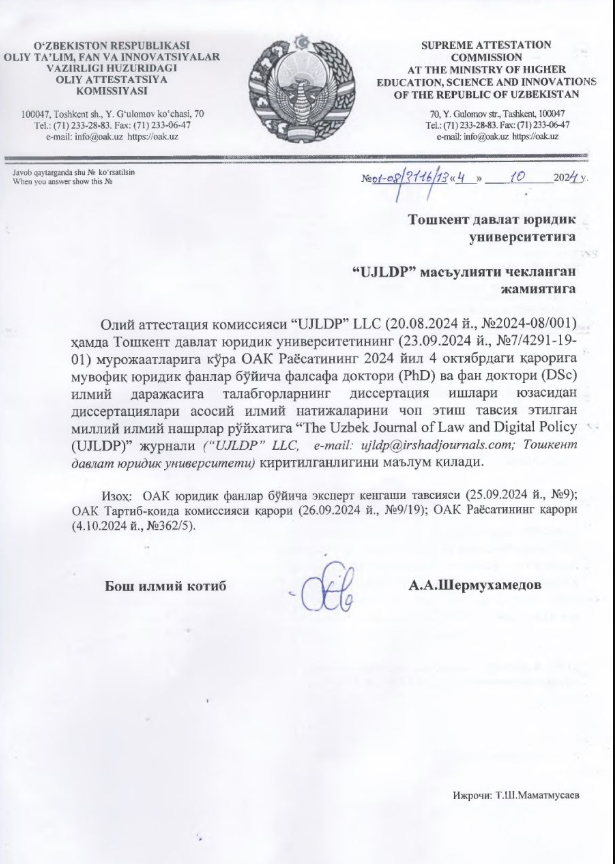
Digital Fatigue in Online Education: Measurement, Risk Factors, and Strategies for Reducing Cognitive Exhaustion
Digital Fatigue in Online Education Measurement, Risk Factors, and Strategies for Reducing Cognitive Exhaustion
DOI:
https://doi.org/10.59022/IRSHAD-ujldp.8Keywords:
Digital Fatigue, Online Education, Cognitive Exhaustion, Risk Factors, Videoconferencing Fatigue, Student Wellbeing, Coping StrategiesAbstract
Online education now shapes daily learning for millions of students worldwide, yet growing screen time creates a quiet but serious problem called digital fatigue. This research examines how fatigue can be measured, which factors increase its severity, and which strategies reduce cognitive exhaustion. The study aims to connect measurement science with practical, usable solutions for institutions and educators. A qualitative approach guided this work, combining doctrinal analysis of relevant laws with detailed document analysis of scholarly literature. Results show fatigue develops through overlapping technological, physical, psychological, and behavioral factors, with structured course design proving more effective than personal coping advice alone. Findings suggest institutions should priorities shorter sessions, clearer schedules, and early behavioral monitoring over individual willpower. This research recommends embedding fatigue reduction within wider institutional digital policy and faculty training programs. Addressing digital fatigue therefore protects academic performance and supports healthier, more sustainable online learning environments for students everywhere.
References
Agrawal, S., et al. (2025). Breaking the cycle: How fatigue, cyberloafing, and self-regulation interact in online learning. Education Sciences, 15(3), 373. https://doi.org/10.3390/educsci15030373
Aguilar, M. V. G. (2024). Pandemic in retrospect: Students' evaluation of distance education during the COVID-19 pandemic. International Journal on Culture History and Religion, 6(2), 15–31. https://doi.org/10.5281/zenodo.13270923
Al Mulhim, E. N. (2024). Techno-anxiety and techno-satisfaction during the COVID-19 pandemic: The case of distance learning. Frontiers in Education, 9, 1384925. https://doi.org/10.3389/feduc.2024.1384925
Allahrakha, N. (2023). Balancing cyber-security and privacy: Legal and ethical considerations in the digital age. Legal Issues in the Digital Age, 4(2), 78–121. https://doi.org/10.17323/2713-2749.2023.2.78.121
AllahRakha, N. (2024). Rethinking digital borders to address jurisdiction and governance in the global digital economy. International Journal of Law and Policy, 2(1). https://doi.org/10.59022/ijlp.124
Bauer, V., & Riedl, R. (2023). Bewältigungsstrategien von Videoconference Fatigue [Coping strategies for videoconference fatigue]. HMD Praxis der Wirtschaftsinformatik, 60(6), 1289–1305. https://doi.org/10.1365/s40702-023-00963-3
Bennett, A. A., Campion, E. D., Keeler, K. R., & Keener, S. K. (2021). Videoconference fatigue? Exploring changes in fatigue after videoconference meetings during COVID-19. Journal of Applied Psychology, 106(3), 330–344. https://doi.org/10.1037/apl0000906
Beyea, D., Lim, C., Lover, A., Foxman, M., Ratan, R., & Leith, A. (2025). Zoom fatigue in review: A me-ta-analytical examination of videoconferencing fatigue's antecedents. Computers in Human Behavior Reports, 17, 100571. https://doi.org/10.1016/j.chbr.2024.100571
Butsripoom, B., & Wittayapun, Y. (2024). Factors associated with musculoskeletal pain and fatigue during online learning among nursing students. Pacific Rim International Journal of Nursing Research, 29(1), 152–165. https://doi.org/10.60099/prijnr.2025.270650
Castro-Figueroa, E., et al. (2026). Empowering community partners in health disparities research: Refining a community-based participatory research (CBPR) training curriculum. Pedagogy in Health Promotion, 12(1), 32. https://doi.org/10.1177/23733799251345430
Cook-Chennault, K. (2025). Do LMS analytics predict student success? A quantitative study of engagement and course performance. Proceedings of the Frontiers in Education Conference (FIE). https://doi.org/10.1109/FIE63693.2025.11328707
Deep, P. D. (2025). Student burnout and mental health in higher education during COVID-19: Online learning fatigue, institutional support, and the role of artificial intelligence. Higher Education Studies, 15(2), 1–15. https://doi.org/10.5539/hes.v15n2p1
Demirbilek, M., & Suvorova, T. (2023). Perspectives on digital burnout in second language acquisition. Ad-vances in Educational Technologies and Instructional Design, 97–115. https://doi.org/10.4018/978-1-6684-9246-8.ch005
Döring, N., Moor, K. D., Fiedler, M., Schoenenberg, K., & Raake, A. (2022). Videoconference fatigue: A con-ceptual analysis. International Journal of Environmental Research and Public Health, 19(4), 2061. https://doi.org/10.3390/ijerph19042061
Doyle, R., Huxta, R., & Soniyi, O. (2025). Up all night: The effect of the COVID-19 pandemic on insomnia among college students. Journal of American College Health, 73(2), 733–742. https://doi.org/10.1080/07448481.2023.2237585
El Maazouzi, Q., et al. (2025). Multimodal detection of emotional and cognitive states in e-learning: Fatigue and attention monitoring. Computers, 14(8), 314. https://doi.org/10.3390/computers14080314
Ewing, L. A., Henderson, M., & Phillips, M. (2021). Technology-enabled remote learning during Covid-19: Perspectives of Australian teachers, students and parents. Technology, Pedagogy and Education, 30(1), 53–69. https://doi.org/10.1080/1475939X.2020.1868562
Fauville, G., Luo, M., Queiroz, A. C. M., Bailenson, J. N., & Hancock, J. (2021). Zoom exhaustion & fatigue scale. Computers in Human Behavior Reports, 4, 100119. https://doi.org/10.1016/j.chbr.2021.100119
Fauville, G., Luo, M., Queiroz, A. C. M., Lee, A., Bailenson, J. N., & Hancock, J. (2023). Video-conferencing usage dynamics and nonverbal mechanisms exacerbate Zoom Fatigue, particularly for women. Computers in Human Behavior Reports, 10, 100271. https://doi.org/10.1016/j.chbr.2023.100271
Guszkowska, M., & Dąbrowska-Zimakowska, A. (2023). Occupational balance, changes in occupations and psychological well-being of university students during the COVID-19 pandemic. Scandinavian Journal of Occupational Therapy, 30(4), 463–473. https://doi.org/10.1080/11038128.2022.2143892
Halupa, C. (2020). Technology fatigue of faculty in higher education. Journal of Education and Practice, 11(30), 1–10. https://doi.org/10.7176/JEP/11-30-01
Kang, J., Tsai, C.-C., & Lee, S. M. (2025). Effects of technological issues on session evaluation in metaverse counseling: The role of psychological symptoms using HLM analysis. Journal of Counseling & Development, 103(2), 172–185. https://doi.org/10.1002/jcad.12548
Kubi, M., Kleespies, M. W., & Wenzel, V. (2025). Comparing Zoom and in-person zoo tours on students' in-terest in animals: A case study during the COVID-19 lockdown. Visitor Studies, 28(1), 1–15. https://doi.org/10.1080/10645578.2025.2532299
Ma, Y., Ren, J., Qiu, Y., & Zhu, J. (2025). A cross-sectional survey of videoconferencing fatigue and its influ-encing factors during COVID-19 in the Chinese population. Scientific Reports, 15(1), 1–12. https://doi.org/10.1038/s41598-025-04157-3
Manukyan, P., Deviaterikova, A., Velichkovsky, B. B., & Kasatkin, V. (2022). The impact of mild COVID-19 on executive functioning and mental health outcomes in young adults. Healthcare, 10(10), 1891. https://doi.org/10.3390/healthcare10101891
Marzban, F., Inan, F. A., & Unal, D. (2025). Learner-related sources of mental fatigue in online education: A scoping review. The Open/Technology in Education, Society, and Scholarship Association Journal, 5(2), 1–35. https://doi.org/10.18357/otessaj.2025.5.2.112
Miranda, J. P. P. (2026). Defining AI fatigue in academic contexts: Dimensions, indicators, and a stage-based model using grounded theory. International Journal of Learning Teaching and Educational Research, 25(5), 91–107. https://doi.org/10.26803/ijlter.25.5.5
Nadler, R. (2020). Understanding "Zoom fatigue": Theorizing spatial dynamics as third skins in comput-er-mediated communication. Computers and Composition, 58, 102613. https://doi.org/10.1016/j.compcom.2020.102613
Öçlü, B., Riedl, R., Whelan, E., & Acton, T. (2024). Information systems and neuroscience: Zoom fatigue and cognitive load. Lecture Notes in Information Systems and Organisation, 68, 309–325. https://doi.org/10.1007/978-3-031-58396-4_27
Oducado, R. M. F., Dequilla, M. A. C. V., & Villaruz, J. F. (2022). Factors predicting videoconferencing fatigue among higher education faculty. Education and Information Technologies, 27(7), 9713–9724. https://doi.org/10.1007/s10639-022-11017-4
Okpako, E., Adewuyi, H., Fehintola, V., Ojuolape, M., Raji, N., Adegoke, A., & Umanhonlen, S. (2026). Digital learning fatigue and its psychological consequences among tertiary students: A systematic review. Educational Technology Quarterly, 2026(2), 99–128. https://doi.org/10.55056/etq.1056
Onyper, S. (2024). Videoconferencing during the COVID-19 pandemic is associated with sleep disruption in young adults. Nature and Science of Sleep, 16, 1583–1595. https://doi.org/10.2147/NSS.S478359
Pacit, R. (2025). Webinar-based education: The opportunities and challenges of using the Zoom meeting ap-plication in the academe. Psychology and Education: A Multidisciplinary Journal, 39(6), 822–835. https://doi.org/10.70838/pemj.390607
Pimenta, A., et al. (2015). Mental workload management as a tool in e-learning. Procedia Computer Science, 75, 234–241. https://doi.org/10.1016/j.procs.2015.12.234
Queiroz, A. C. M., Lee, A. Y., Luo, M., Fauville, G., Bailenson, J. N., & Hancock, J. (2023). Too tired to connect: Understanding the associations between video-conferencing, social connection and well-being through the lens of zoom fatigue. Computers in Human Behavior, 149, 107968. https://doi.org/10.1016/j.chb.2023.107968
Ratan, R., Lin, Q., Lim, C., Park, R., Lover, A., Han, E., Jang, D., Leith, A. P., & Bailenson, J. N. (2025). Time matters in VR: Students benefit from longer VR class duration, but certain outcomes decline after 45 minutes, with large individual variance. Computers & Education, 235, 105328. https://doi.org/10.1016/j.compedu.2025.105328
Reed, H. C. (2022). E-Learning fatigue and the cognitive, educational, and emotional impacts on communication sciences and disorders students during COVID-19. Perspectives of the ASHA Special Interest Groups, 7(5), 1135–1148. https://doi.org/10.1044/2022_PERSP-22-00049
Riedl, R. (2021). On the stress potential of videoconferencing: Definition and root causes of Zoom fatigue. Electronic Markets, 31(4), 789–804. https://doi.org/10.1007/s12525-021-00501-3
Romero-Rodríguez, J. M., García-González, L., & Fernández-Cruz, M. (2023). Digital fatigue in university students as a consequence of online education. Comunicar, 31(74), 65–76. https://doi.org/10.3916/C74-2023-05
Salim, J., Tandy, S., Arnindita, J. N., Wibisono, J. J., Haryanto, M. R., & Wibisono, M. G. (2022). Zoom fatigue and its risk factors in online learning during the COVID-19 pandemic. Medical Journal of Indonesia, 31(1), 13–19. https://doi.org/10.13181/mji.oa.225703
Shoshan, H. N., & Wehrt, W. (2022). Understanding "Zoom fatigue": A mixed-method approach. Applied Psychology, 71(4), 1313–1341. https://doi.org/10.1111/apps.12360
Sinnokrot, S., et al. (2026). Digital fatigue and cognitive load in e-learning: Evidence from nursing students. Journal of Nursing Scholarship. https://doi.org/10.1002/nop2.70795
Sukhanonsawat, N. (2024). Medical students' Zoom fatigue in a Thai medical school during the COVID-19 pandemic. Education in Medicine Journal, 16(1), 47–55. https://doi.org/10.21315/eimj2024.16.1.4
Downloads
Published
Issue
Section
License
Copyright (c) 2026 Saidasror Gulyamov (Author)

This work is licensed under a Creative Commons Attribution 4.0 International License.