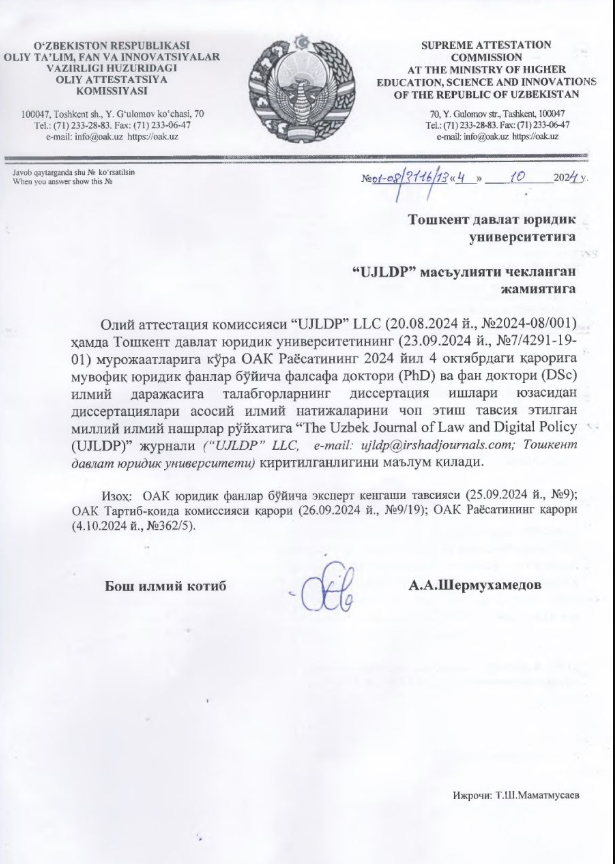
Explainable AI in Automated Assessment How to Make Algorithmic Grading Transparent for Students and Teachers
DOI:
https://doi.org/10.59022/IRSHAD-ujldp.3Keywords:
Explainable Artificial Intelligence, Algorithmic Grading, Automated Assessment, Educational Transparency, Student Trust, Teacher Accountability, Legal Regulation Of AIAbstract
Automated grading systems increasingly score student work without explaining their scoring decisions. This opacity creates confusion for students and weakens trust among classroom teachers. This research examines how explainable artificial intelligence can make algorithmic grading transparent. The study aims to identify practical methods that clarify grading decisions for students and teachers. It explores which explanation formats build meaningful trust within real classroom settings. A qualitative approach guided this research, combining doctrinal legal analysis with document analysis. Legal frameworks, scholarly literature, and classroom findings were reviewed systematically throughout this study. Results show explanation features improved student understanding and strengthened teacher confidence significantly. Visible grading logic also helped teachers detect bias and reduce grading disputes. This research recommends embedding explanation features within every automated grading system used. Institutions should also pair legal transparency requirements with practical classroom implementation support. These findings suggest explain ability remains essential, not optional, for trustworthy automated assessment systems..
References
Adadi, A., & Berrada, M. (2018). Peeking inside the black-box: A survey on Explainable Artificial Intelligence (XAI). IEEE Access, 6, 52138–52160. https://doi.org/10.1109/ACCESS.2018.2870052
AllahRakha, N. (2024). Cybersecurity regulations for protection and safeguarding digital assets (data) in today’s worlds. Lex Scientia Law Review, 8(1), 405–432. https://doi.org/10.15294/lslr.v8i1.2081
AllahRakha, N. (2024). Transformation of crimes (cybercrimes) in digital age. International Journal of Law and Policy, 2(2), 1–15. https://doi.org/10.59022/ijlp.156
Arrieta, A. B., Díaz-Rodríguez, N., Del Ser, J., Bennetot, A., Tabik, S., Barbado, A., ... & Herrera, F. (2020). Ex-plainable Artificial Intelligence (XAI): Concepts, taxonomies, opportunities and challenges toward re-sponsible AI. Information Fusion, 58, 82–115. https://doi.org/10.1016/j.inffus.2019.12.012
Baker, R. S., & Hawn, A. (2022). Algorithmic bias in education. International Journal of Artificial Intelligence in Education, 32(2), 574–605. https://doi.org/10.1007/s40593-021-00264-0
Bekrar, A., Ait El Cadi, A., Todosijevic, R., & Sarkis, J. (2021). Digitalizing the closing-of-the-loop for supply chains: A transportation and blockchain perspective. Sustainability, 13(5), 2895. https://doi.org/10.3390/su13052895
Buccafurri, F., Fotia, L., & Lax, G. (2016). Implementing advanced electronic signature by public digital identity system (SPID). Lecture Notes in Computer Science, 265–279. https://doi.org/10.1007/978-3-319-44159-7_21
Burri, M., & Polanco, R. (2020). Digital trade provisions in preferential trade agreements: Introducing a new dataset. Journal of International Economic Law, 23(1), 187–215. https://doi.org/10.1093/jiel/jgz044
Chen, L., Chen, P., & Lin, Z. (2020). Artificial intelligence in education: A review. IEEE Access, 8, 75264–75278. https://doi.org/10.1109/ACCESS.2020.2988510
Fernández-Alemán, J., Señor, I., Lozoya, P., & Toval, A. (2013). Security and privacy in electronic health rec-ords: A systematic literature review. Journal of Biomedical Informatics, 46(3), 541–562. https://doi.org/10.1016/j.jbi.2012.12.003
Gabriel, H. (2006). The United Nations Convention on the Use of Electronic Communications in International Contracts: An overview and analysis. Uniform Law Review, 11(2), 285–303. https://doi.org/10.1093/ulr/11.2.285
Garcia-Teruel, R., & Simón-Moreno, H. (2021). The digital tokenization of property rights: A comparative perspective. Computer Law & Security Review, 41, 105543. https://doi.org/10.1016/j.clsr.2021.105543
Ginsburg, T. (2020). Authoritarian international law? American Journal of International Law, 114(2), 221–242. https://doi.org/10.1017/ajil.2020.3
Gkrimpizi, T., Peristeras, V., & Magnisalis, I. (2023). Classification of barriers to digital transformation in higher education institutions: Systematic literature review. Education Sciences, 13(7), 746. https://doi.org/10.3390/educsci13070746
Ifenthaler, D., & Yau, J. Y. K. (2020). Utilising learning analytics to support study success in higher education: A systematic review. Educational Technology Research and Development, 68(4), 1961–1987. https://doi.org/10.1007/s11423-020-09786-1
Imamanazarova, A. (2024). The civil law regime of an electronic document in business activity in the regions of Central Asia. Global Biosecurity, 5(1), 224. https://doi.org/10.31646/gbio.224
Jobin, A., Ienca, M., & Vayena, E. (2019). The global landscape of AI ethics guidelines. Nature Machine Intelli-gence, 1(9), 389–399. https://doi.org/10.1038/s42256-019-0088-2
John, U. (2022). Implementing the electronic signature law in Tanzania – successes, challenges, and prospects. Digital Evidence and Electronic Signature Law Review, 19, 1–12. https://doi.org/10.14296/deeslr.v19i0.5467
Lentner, G., & Parycek, P. (2016). Electronic identity (eID) and electronic signature (eSig) for eGovernment services – a comparative legal study. Transforming Government: People, Process and Policy, 10(1), 45–62. https://doi.org/10.1108/tg-11-2013-0047
Mamadiyorov, Z., Sultanova, N., Makhmudov, S., Khamdamov, S., Mirpulatova, L., & Jumayev, A. (2023). The impact of digitalization on microfinance services in Uzbekistan. Proceedings of the 7th International Conference on Future Networks and Distributed Systems, 112–118. https://doi.org/10.1145/3644713.3644780
Manento, S. (2026). Regulating trust in the digital age: A critical analysis of the legal framework on electronic signatures and its implications for secure transactions in Tanzania. East African Journal of Law and Ethics, 9(2), 309–322. https://doi.org/10.37284/eajle.9.2.5151
Manoharan, A., Melitski, J., & Holzer, M. (2023). Digital governance: An assessment of performance and best practices. Public Organization Review, 23(1), 1–20. https://doi.org/10.1007/s11115-021-00584-8
Mason, S. (2012). Electronic signatures in law (3rd ed.). Cambridge University Press. https://doi.org/10.1017/cbo9780511998058
Mason, S. (2014). World electronic signature legislation. Digital Evidence and Electronic Signature Law Review, 10, 1–15. https://doi.org/10.14296/deeslr.v10i0.2014
Mason, S. (2020). World electronic signature legislation. Digital Evidence and Electronic Signature Law Review, 16, 1–20. https://doi.org/10.14296/deeslr.v16i0.5085
Mason, S. (2022). World electronic signature legislation. Digital Evidence and Electronic Signature Law Review, 16, 1–22. https://doi.org/10.14296/deeslr.v16i0.5092
Mehrabi, N., Morstatter, F., Saxena, N., Lerman, K., & Galstyan, A. (2021). A survey on bias and fairness in machine learning. ACM Computing Surveys, 54(6), 1–35. https://doi.org/10.1145/3457607
Mittelstadt, B. (2019). Principles alone cannot guarantee ethical AI. Nature Machine Intelligence, 1(11), 501–507. https://doi.org/10.1038/s42256-019-0114-4
Montavon, G., Samek, W., & Müller, K. R. (2018). Methods for interpreting and understanding deep neural networks. Digital Signal Processing, 73, 1–15. https://doi.org/10.1016/j.dsp.2017.10.011
Muminova, E., Honkeldiyeva, G., Kurpayanidi, K., Akhunova, S., & Hamdamova, S. (2020). Features of in-troducing blockchain technology in digital economy developing conditions in Uzbekistan. E3S Web of Conferences, 159, 04023. https://doi.org/10.1051/e3sconf/202015904023
Nita, S., & Mihailescu, M. (2024). A novel authentication scheme based on verifiable credentials using digital identity in the context of Web 3.0. Electronics, 13(6), 1137. https://doi.org/10.3390/electronics13061137
Putra, D., & Hidayaturrahman, M. (2020). The roles of technology in al-Quran exegesis in Indonesia. Technology in Society, 63, 101418. https://doi.org/10.1016/j.techsoc.2020.101418
Rakhmonova, M. (2023). Analysis of the legal practice of Uzbekistan and EU countries in the field of legal regulation of blockchain and cryptocurrency. Общество и инновации [Society and Innovations], 3(11/S), 270–282. https://doi.org/10.47689/2181-1415-vol3-iss11/s-pp270-282
Rudin, C. (2019). Stop explaining black box machine learning models for high stakes decisions and use interpretable models instead. Nature Machine Intelligence, 1(5), 206–215. https://doi.org/10.1038/s42256-019-0048-x
Salomova, S. (2023). Ways to use intellectual platforms in the Republic of Uzbekistan. E3S Web of Conferences, 384, 01060. https://doi.org/10.1051/e3sconf/202338401060
Sung, B. (2016). The law political review on the change from paper document to electronic document. Journal of Law and Politics Research, 16(2), 33–58. https://doi.org/10.17926/kaolp.2016.16.2.33
Tulakhodjaeva, M., & Khodjaeva, M. (2021). Features of digitalization and ensuring transparency of accounting and audit in Uzbekistan. Proceedings of the 5th International Conference on Future Networks & Distributed Systems, 1–6. https://doi.org/10.1145/3508072.3508201
Tverdova, T., & Mukhlynina, M. (2022). Legal regulation of relations using digital technologies. Юридическая мысль [Legal Thought], 1(125), 58–65. https://doi.org/10.47905/matgip.2022.125.1.010
World Intellectual Property Organization. (2022). Electronic signature law update: Global legislative trends. Digital Economy Papers. https://doi.org/10.14296/deeslr.v19i0.5475
Zopfi-Jordan, D. (2012). Helping the "non-law" librarian understand law library requirements for interlibrary loan copy requests. Journal of Interlibrary Loan, Document Delivery & Electronic Reserve, 22(2), 89–102. https://doi.org/10.1080/1072303x.2012.709220
Downloads
Published
Issue
Section
License
Copyright (c) 2026 Jahongir Babaev (Author)

This work is licensed under a Creative Commons Attribution 4.0 International License.