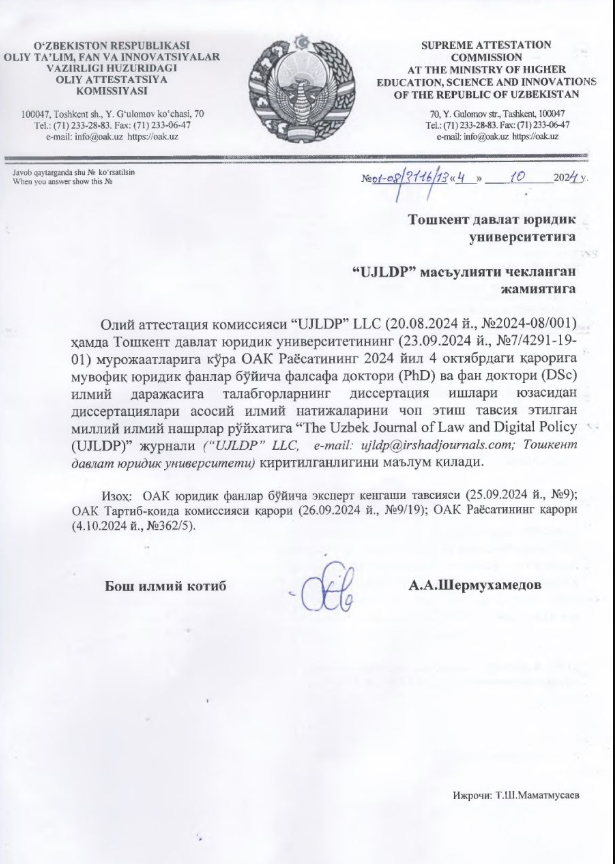
Contemporary Trends and Features of the Manifestation of Slavery in the Context of Globalization and Digitalization
DOI:
https://doi.org/10.59022/IRSHAD-ujldp.2Keywords:
Contemporary Slavery, Modern Slavery, Human Trafficking, Forced Labour, Globalization, Digitalization, Debt bondageAbstract
Contemporary slavery persists despite its universal legal prohibition, and its forms are changing under the pressure of globalization and digitalization. This article examines how these processes transform the recruitment, control, and organization of exploitation, and how international law classifies the resulting practices. Using qualitative doctrinal and document analysis of treaties, case law, official reports, and scholarship, the study distinguishes slavery in the strict legal sense from servitude, forced labour, debt bondage, trafficking in persons, and forced criminality. The results identify six interrelated trends: concealment of ownership-like control behind formal consent, transnational and supply chain exploitation, digital recruitment and control, remote exploitation, persistent structural vulnerability, and the growing need for precise classification. The article concludes that technology changes the means of exploitation without creating a new legal category, and it recommends precise classification, victim non-punishment, platform accountability, and stronger cooperation on electronic evidence.
References
Allain, J. (Ed.). (2012). The legal understanding of slavery: From the historical to the contemporary. Oxford University Press. https://doi.org/10.1093/acprof:oso/9780199660469.001.0001
Allain, J., & Bales, K. (2012). Slavery and its definition. Global Dialogue, 14(2), 6–14. https://hull-repository.worktribe.com/output/471418
Bales, K. (2012). Disposable people: New slavery in the global economy (3rd ed.). University of California Press. https://www.ucpress.edu/books/disposable-people/paper
Chuang, J. A. (2014). Exploitation creep and the unmaking of human trafficking law. American Journal of Inter-national Law, 108(4), 609–649. https://doi.org/10.5305/amerjintelaw.108.4.0609
Cliffe Dekker Hofmeyr. (2026, June 29). International Labour Organization adopts landmark Convention on decent work in the platform economy. https://www.cliffedekkerhofmeyr.com/en/news/publications/2026/South-Africa/Employment-Law/employment-law-alert-29-june-International-Labour-Organization-adopts-landmark-Convention-on-Decent-Work-in-the-Platform-Economy
Clifford Chance. (2026, February 24). Omnibus I: The European Union concludes CSDDD and CSRD reforms. https://www.cliffordchance.com/insights/resources/blogs/business-and-human-rights-insights/2026/02/omnibus-i-the-european-union-concludes-csddd-and-csrd-reforms.html
Crane, A. (2013). Modern slavery as a management practice: Exploring the conditions and capabilities for human exploitation. Academy of Management Review, 38(1), 49–69. https://doi.org/10.5465/amr.2011.0145
Davidson, J. O. (2015). Modern slavery: The margins of freedom. Palgrave Macmillan. https://doi.org/10.1057/9781137297297
Gallagher, A. T. (2010). The international law of human trafficking. Cambridge University Press. https://doi.org/10.1017/CBO9780511761065
Gallagher, A. T. (2017). What's wrong with the Global Slavery Index? Anti-Trafficking Review, 8, 90–112. https://doi.org/10.14197/atr.20121786
Landman, T. (2020). Measuring modern slavery: Law, human rights, and new forms of data. Human Rights Quarterly, 42(2), 303–331. https://doi.org/10.1353/hrq.2020.0019
Latonero, M. (2011). Human trafficking online: The role of social networking sites and online classifieds. USC An-nenberg Center on Communication Leadership & Policy. https://technologyandtrafficking.usc.edu/report/
Lebedinets, I. N. (2016). Genezis mezhdunarodno-pravovogo regulirovaniya bor'by s rabstvom, rabotorgovlei i drugimi formami torgovli lyud'mi [Genesis of the international legal regulation of the fight against slavery, the slave trade, and other forms of human trafficking]. Aktual'nye problemy rossiiskogo prava, 3(64), 186–191. https://doi.org/10.17803/1994-1471.2016.64.3.186-191
Mendel, J., & Sharapov, K. (2016). Human trafficking and online networks: Policy, analysis, and ignorance. Antipode, 48(3), 665–684. https://doi.org/10.1111/anti.12213
New, S. J. (2015). Modern slavery and the supply chain: The limits of corporate social responsibility? Supply Chain Management: An International Journal, 20(6), 697–707. https://doi.org/10.1108/SCM-06-2015-0201
Sarkar, S. (2015). Use of technology in human trafficking networks and sexual exploitation: A cross-sectional multi-country study. Transnational Social Review, 5(1), 55–68. https://doi.org/10.1080/21931674.2014.991184
Downloads
Published
Issue
Section
License
Copyright (c) 2026 Komila Rashidova (Author)

This work is licensed under a Creative Commons Attribution 4.0 International License.