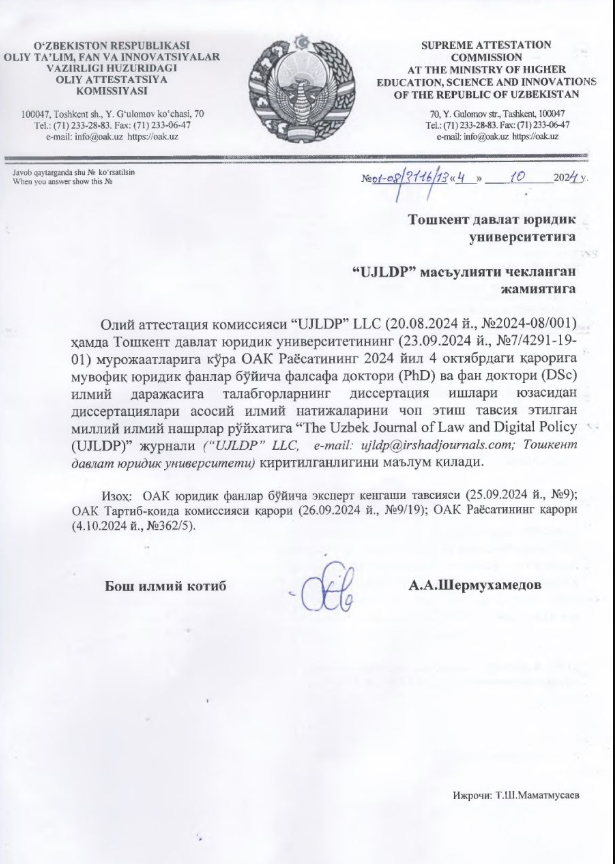
Problems of Qualification of Criminal Offenses in the Sphere of Crypto-Assets Turnover and Mining
DOI:
https://doi.org/10.59022/IRSHAD-ujldp.14Keywords:
Crypto-Assets, Criminal Qualification, Crypto jacking, Illegal Mining, Money Laundering, Bribery, Fungible TokensAbstract
Crypto-assets have created new opportunities for crime that existing criminal codes struggle to classify. Bribes, laundered funds, and stolen computing power now move through block chain networks. This study aims to examine problems of criminal qualification in crypto-assets turnover and mining. It seeks to identify gaps in offence definitions and propose a coherent liability model. The research adopts a qualitative design based on doctrinal and document analysis. It reviews Uzbek legislation, European Union regulations, Russian law, and scholarly literature. The results show that the unclear legal status of tokens weakens property and bribery offences. Laundering through mixers and non-fungible tokens escapes traditional definitions. Crypto jacking lacks a clear offence category, while illegal mining harms energy security and the environment. The study recommends recognizing crypto-assets as property for criminal purposes. It also proposes specific offences for crypt jacking and large-scale illegal mining. Clear rules would strengthen deterrence, protect victims, and support lawful digital innovation.
References
Brown, A. B., Davis, C. D., & Wilson, E. F. (2024). Contractual frameworks in smart city ecosystems: A sys-tematic review. Journal of Urban Technology, 31(2), 145-167. https://doi.org/10.1080/10630732.2024.123456
Adaramola, O. (2025). The dark arts of crypto laundering and the Nigerian financial ecosystem: Examining regulatory perspectives of virtual assets. Journal of Economic Criminology. https://doi.org/10.1016/j.jeconc.2024.100117
Adem, M. A. (2026). Reflecting on the EU’s exclusive external competence in crypto assets. European Web Journal of Law. https://doi.org/10.14324/111.444.ewlj.2026.01
Ageev, V. N. (2025). Cryptocurrency as a subject of bribery: Issues of legal qualification. Questions of Russian and International Law, 15(6). https://doi.org/10.7256/2454-0692.2025.6.77281
Al-Balushi, R. H. (2025). Criminal liability for money laundering and terrorist financing through non-fungible tokens. International Annals of Criminology. https://doi.org/10.1017/cri.2025.10114
Alekhin, D. E. (2025). Qualification of crimes related to obtaining cryptocurrency (mining). Courier of Kutafin Moscow State Law University (MSAL). https://doi.org/10.17803/2311-5998.2025.129.5.058-064
AllahRakha, N. (2024a). Cybercrime and the law: Addressing the challenges of digital forensics in criminal investigations. Mexican Law Review, 16(2).
AllahRakha, N. (2024b). Cybercrime and the legal and ethical challenges of emerging technologies. Interna-tional Journal of Law and Policy, 2(5), 28–36.
Antwi, S. (2023). Anti-money laundering measures and financial sector stability in the era of cryptocurrency. Journal of Financial Crime. https://doi.org/10.1108/JFC-03-2023-0045
Arnone, G. (2025). The (mis)use of cryptocurrencies by criminal organizations. European Journal on Criminal Policy and Research. https://doi.org/10.1007/s42521-025-00148-1
Balaji, A. (2023). Wire fraud on the blockchain: Backdoor prosecutions of insider trading and crypto assets. SSRN Electronic Journal. https://doi.org/10.2139/ssrn.4745419
Benson, V., Adamyk, B., Chinnaswamy, A., & Adamyk, O. (2024). Harmonising cryptocurrency regulation in Europe: Opportunities for preventing illicit transactions. European Journal of Law and Economics, 57(1). https://doi.org/10.1007/s10657-024-09797-w
Blancaflor, E., Dionisio, P. J., Juacalla, D. J., Oraya, A., & Yabut, J. A. (2024). Cryptojacking: A comprehensive review of attack techniques, victims, and effective mitigation strategies. In Proceedings of the 7th International Conference on Information Systems Security and Privacy. https://doi.org/10.1145/3700706.3700713
Fernando, Z. J. (2025). Crypto mining as a threat to energy and the environment from the perspective of criminal law reform. FinTech, 4(2), 1–11. https://doi.org/10.3390/FINTECH4020011
Gáspár, Z. (2024). The criminalization of cryptojacking in Hungary. Przegląd Policyjny, 8(2). https://doi.org/10.31261/PPK.2024.08.02.01
Jokić, D. (2021). A Twitter corpus and lexicon for abusive speech detection: Criminal offenses committed on social networks. Language Resources and Evaluation. https://doi.org/10.1007/s10579-012-9182-3
Kushnirenko, S. P. (2023). Cryptocurrencies turnover and forensic analysis of the criminal qualification. Kriminalistyka. https://doi.org/10.33998/2307-5113.2023.1.189
Longa, F. A. (2025). Cryptocurrency and money laundering: Regulatory effectiveness in criminal law. American Journal of Industrial and Business Management. https://doi.org/10.6000/2817-2302.2022.01.02
Mačernytė-Panomariovienė, I. (2024). The dynamics of modern legal order: Criminal offenses and virtual assets. Journal of Organizational Behavior. https://doi.org/10.1002/job.699
Mauko, E., Rubini, S., & Igwe, C. (2026). Evolving trends in cryptomining malware: A systematic literature review. Crime Science, 15(1), 14. https://doi.org/10.1186/s40163-025-00267-5
Moiseienko, A. (2025). Doing business with criminals: Between exclusion and surveillance. Cambridge University Press. https://doi.org/10.1017/9781009609845
Nadareishvili, I. (2022). Cryptocurrency-related cybercrime types and threats: Focus on cryptojacking. Law and World. https://doi.org/10.32849/2663-5313/2022.1.15
Nazzari, M. (2025). How well does the money laundering control system work? Journal of Law and Economics. https://doi.org/10.1086/735665
Olushola, A. (2025). The largest unified dataset of CEX and DEX incidents: Criminal liability in crypto ex-changes. Frontiers in Blockchain. https://doi.org/10.3389/fbloc.2025.1713637
Ordekian, M. (2024). Physical attacks targeting cryptocurrency users. In Leibniz International Proceedings in Informatics (LIPIcs). https://doi.org/10.4230/LIPIcs.AFT.2024.24
Popov, D., & Rubtsov, G. (2024). Digital signal processing in cryptojacking detection and criminal liability. Digital Signal Processing. https://doi.org/10.1016/j.dsp.2024.104594
Pratiwi, A. M. (2026). Gender, vulnerability, and power in Indonesia’s climate: Criminal law aspects of illegal crypto mining. Climate and Development. https://doi.org/10.1177/27539687221114887
Royer, S. (2023). Criminal law and technology in cryptojacking. In Research handbook on criminal law and technology. Edward Elgar Publishing. https://doi.org/10.4337/9781803921327.00020
Sanz-Bas, D. (2021). Cryptocurrencies and fraudulent transactions: Risks and perspectives. Laws, 10(3), 57. https://doi.org/10.3390/laws10030057
Sharma, A. M. (2021). Cryptocurrency and financial risks: Criminal liability in money laundering. Scholars Crossing. https://doi.org/10.32849/2663-5313/2021.4.22
Shchehlakov, I. (2025). Problems of differentiating crypto-terms in the qualification of criminal offenses against property. Journal of Law and Social Development. https://doi.org/10.1007/s11196-023-10083-2
Sigler, K. (2018). How cyber-criminals are exploiting the crypto-currency boom: Cryptojacking and criminal law. Network Security, 2018(11), 5–8. https://doi.org/10.1016/S1361-3723(18)30086-1
Smith, D. (2024). Money laundering, terrorist financing and virtual assets: Criminal qualification. Springer. https://doi.org/10.1007/978-3-031-59842-5
Tiwari, I. D., Kasturi, Y., & Deeba, S. (2026). Combating digital money laundering: Criminal law perspectives on blockchain-based financial systems. Economic Sciences, 22(3), 339–346. https://doi.org/10.69889/c4e8jt80
Tonry, M. (2026). Comparative studies of sentencing: Criminal law responses to crypto offenses. Crime and Justice. https://doi.org/10.1086/739848
Troitiño, D. R., & Hamuľák, O. (Eds.). (2023). Europe’s criminal law and crypto-assets. Springer. https://doi.org/10.1007/978-3-031-27312-4
Trozze, A. (2022). Cryptocurrencies and future financial crime. Technology in Society. https://doi.org/10.1016/j.techsoc.2021.101832
Usatii, V. (2026). Prospects for improving forensic support in the investigation of crimes involving virtual assets. Actual Problems of Civil Law and Process. https://doi.org/10.32353/acfs.1.2020.09
Venkatasubramanian, G. (2024). Artificial intelligence and criminal justice: Data mining in crypto crime investigation. Statistics and Data Mining. https://doi.org/10.1002/sam.11659
Watters, C. (2023). When criminals abuse the blockchain: Establishing personal jurisdiction in a decentralised environment. Laws, 12(2), 33. https://doi.org/10.3390/laws12020033
Wiwoho, J. (2024). Cryptocurrency mining policy to protect the environment. Cogent Social Sciences, 10(1). https://doi.org/10.1080/23311886.2024.2323755
Xu, G., Dong, W., Xing, J., Lei, W., Liu, J., Gong, L., Feng, M., Zheng, X., & Liu, S. (2023). Delay-CJ: A novel cryptojacking covert attack method based on delayed strategy and its detection. Digital Communications and Networks, 9(5). https://doi.org/10.1016/j.dcan.2022.04.030
Downloads
Published
Issue
Section
License
Copyright (c) 2026 Bakhtiyor Primov (Author)

This work is licensed under a Creative Commons Attribution 4.0 International License.